Learn where radon comes from, why it matters, and how testing and mitigation can reduce your exposure.
01 / The basics
It starts in the ground. It can build up indoors.
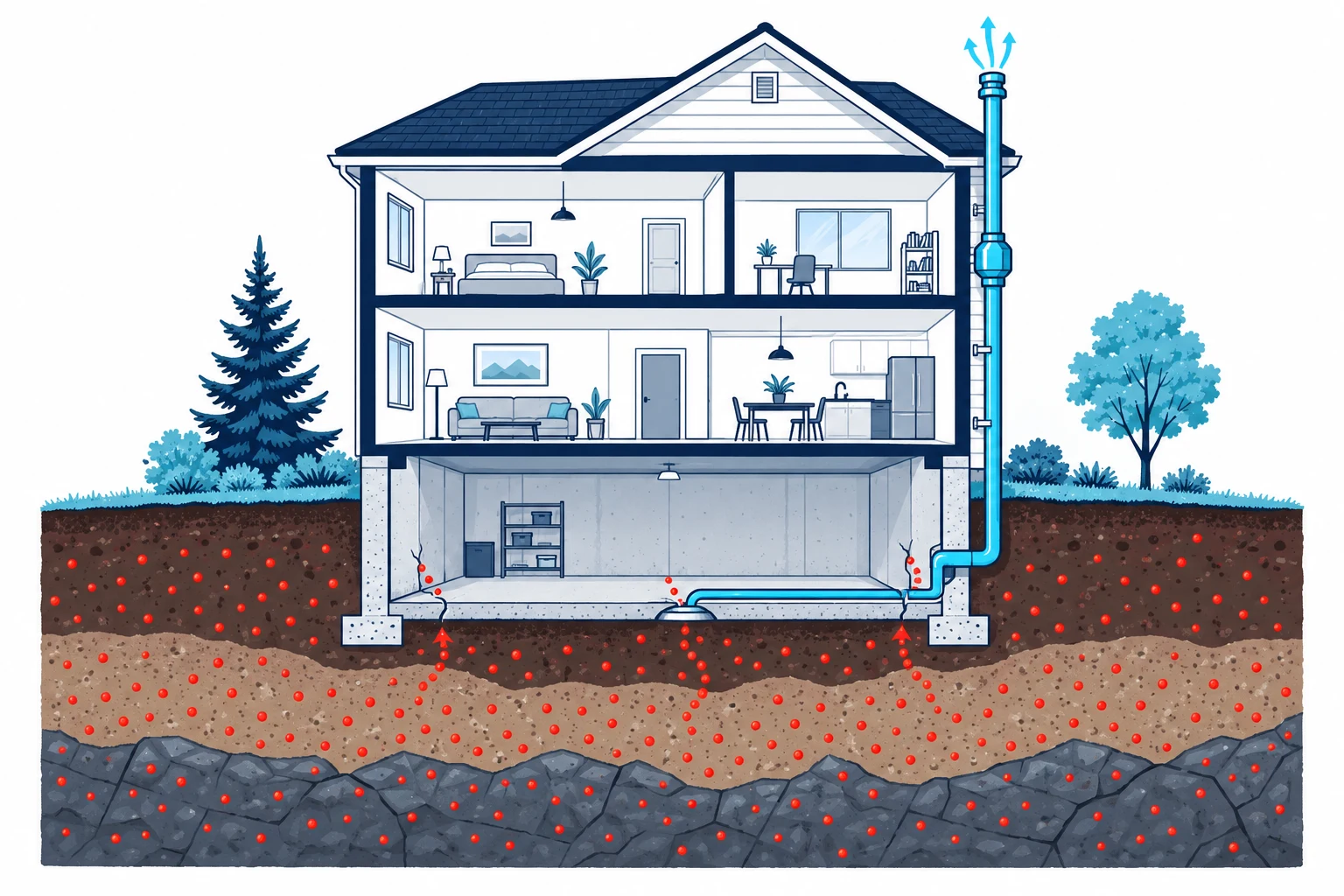
Radon is a radioactive gas released as uranium naturally breaks down in rock and soil. You cannot see, smell or taste it.
Outside, it disperses into the air. Inside a home, it can accumulate after entering through foundation cracks, construction joints and gaps around pipes or drains.
You cannot tell your home’s radon level by looking at it. Testing is the way to find out.
A home’s foundation connects it to the soil below. The extraction system shown is explained in chapter 04. Concept illustration, not an installation design.
02 / Your health
A long-term risk you can act on.
Breathing radon decay products exposes lung tissue to radiation. Over time, this can damage cells and increase the risk of lung cancer.
Risk depends on the concentration, how long you are exposed and smoking. Smoking and radon together increase risk further. Radon is the leading cause of lung cancer among non-smokers.
Testing your home measures the air; it does not diagnose a health condition. Speak with a healthcare professional about personal health concerns.
A long-term detector quietly samples the air. Follow the placement instructions for your device and home.
03 / Testing
A small device. A clearer picture.
Choose a long-term test kit or an electronic monitor that has passed C-NRPP performance testing. Test for at least three months; a brief reading does not give the same long-term picture.
Place it thoughtfully. Use the lowest lived-in level, at breathing height and away from windows, vents, heat and moisture. Follow Health Canada’s placement guidance.
Let the test run. Record the start date and set a reminder. Keep your kit instructions and return materials.
Complete the process. Return a passive detector to its lab, or review your electronic monitor’s long-term average.
Health Canada advises reducing levels of 200 Bq/m³ or higher within one year. Higher levels call for faster action.
Sources reviewed 22 September 2026. General education for homes; building-specific measurement and mitigation plans need qualified professional guidance.